
The zodiac signs describe how energy moves. The planets describe what is moving. The houses describe where — the specific arenas of life in which that energy expresses itself.
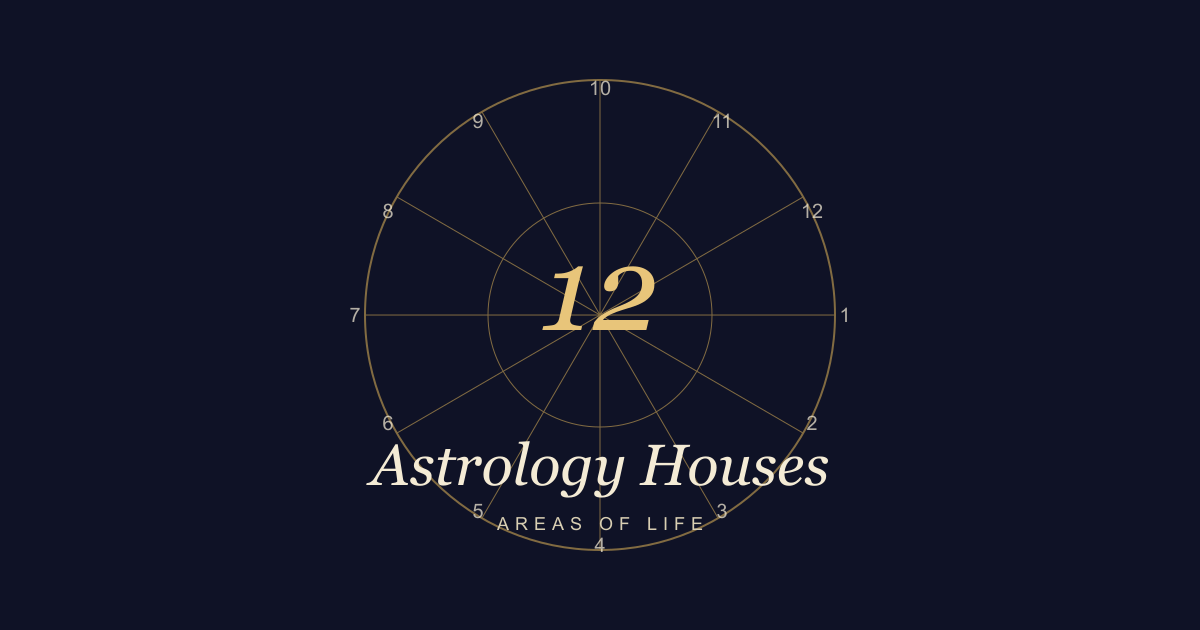
In a natal chart, the twelve houses are like twelve rooms in a house, each with its own function, atmosphere, and territory. When a planet occupies a house, it means that planet’s themes are prominent in that life domain. When a house is empty, it doesn’t mean that area of life is absent — it simply means no planetary emphasis is concentrated there.
Understanding the houses transforms a birth chart from a collection of symbols into a map of a life.
The Angular Houses (1, 4, 7, 10)
These are the most powerful houses in the chart. Planets placed here tend to express themselves strongly and visibly. The four angles — Ascendant, IC, Descendant, and Midheaven — are the structural pillars of the chart.
First House: Self, Appearance, and First Impressions
Natural ruler: Aries | Associated planet: Mars
The first house is the house of the self — specifically, the self as encountered by the world. It is governed by your rising sign (ascendant) and describes your physical appearance, your first impression on others, and your instinctive approach to new situations and beginnings.
Planets in the first house are highly visible in a person’s personality. Mars here creates directness and physical energy. Venus here softens the presentation and adds charm. Saturn here creates a serious, composed exterior that often hides considerable warmth.
Second House: Money, Possessions, and Values
Natural ruler: Taurus | Associated planet: Venus
The second house governs material resources — money, possessions, and everything you own or acquire in this lifetime. It also governs your values: what you consider important enough to work for, protect, or cherish.
Beyond material wealth, the second house describes your relationship with your own worth — both financial and personal. Planets here indicate how money moves through your life and what your deepest values actually are, as distinct from what you think they should be.
Third House: Communication, Siblings, and Local Life
Natural ruler: Gemini | Associated planet: Mercury
The third house governs communication in all its forms — speaking, writing, listening, and the exchange of information. It also covers siblings, early education, the immediate local environment (your neighbourhood, your commute, your daily interactions), and short-distance travel.
Mercury here tends to produce sharp, quick minds and prolific communicators. Saturn here can indicate a more careful, structured approach to communication — often someone who thinks before they speak and chooses words with precision.
Fourth House: Home, Family, and Roots
Natural ruler: Cancer | Associated planet: Moon
The fourth house, sitting at the very base of the chart (the IC or Imum Coeli), represents the foundation of your life — your family of origin, your early home environment, and the psychological roots that everything else grows from. It also governs your adult home life, your sense of belonging, and your private interior world.
The fourth house describes what home means to you and where your deepest security comes from. Planets here shape the nature of your childhood home and your relationship to it throughout life.
Fifth House: Creativity, Romance, and Play
Natural ruler: Leo | Associated planet: Sun
The fifth house is the domain of self-expression: creative projects, romantic affairs, children, pleasure, play, and everything you do for joy rather than obligation. It is one of the chart’s most joyful houses when activated.
Romance in the fifth house is distinguished from partnership (seventh house) by its quality: fifth house romance is passionate, spontaneous, and personal — it’s about the rush of being desired, the thrill of creating together. Venus here indicates a naturally romantic, creative personality. Jupiter here tends to produce great generosity of spirit and enthusiasm for life’s pleasures.
Sixth House: Work, Health, and Daily Routine
Natural ruler: Virgo | Associated planet: Mercury
The sixth house governs work (in the sense of day-to-day tasks and service, rather than career), health and the body, daily routines, and relationships with co-workers. It is the house of maintenance — the unglamorous but essential work of keeping your life, your body, and your systems functioning.
Sixth house placements reveal a great deal about how someone relates to their health and habits. Pluto here tends to produce intense, transformative attitudes toward the body. Jupiter here can indicate good fortune with health matters, though sometimes an indulgent relationship with the body’s signals.
Seventh House: Partnerships and Open Enemies
Natural ruler: Libra | Associated planet: Venus
The seventh house governs all one-to-one partnerships: marriage, business partners, long-term relationships, and significant others. It also, in traditional astrology, governs open enemies — the people you are in direct, declared opposition to.
The seventh house is opposite the first: where the first house is the self, the seventh house is the other. Planets here describe the qualities you seek (or attract) in partners, and often illuminate the shadow qualities you haven’t fully integrated in yourself.
Eighth House: Death, Transformation, and Shared Resources
Natural ruler: Scorpio | Associated planet: Pluto (traditional: Mars)
The eighth house is one of astrology’s most misunderstood domains. It governs death — not only literal death, but all forms of endings, transformation, and the cycles of dissolution and renewal. It also covers other people’s money and resources (inheritance, taxes, debt, investments), as well as the deep psychological territory accessed through intimacy.
The eighth house is where what is hidden lives. Planets here operate in private, complex ways, often producing profound transformation after significant difficulty.
Ninth House: Philosophy, Higher Learning, and Long Travel
Natural ruler: Sagittarius | Associated planet: Jupiter
The ninth house governs the search for meaning: higher education, philosophy, religion and spirituality, long-distance travel, foreign cultures, publishing, and the broad frameworks through which we make sense of existence.
The ninth house expands beyond the familiar. Where the third house is local, the ninth is global. Where the third governs information, the ninth governs wisdom. Jupiter here produces a naturally philosophical, expansive personality with an insatiable appetite for learning.
Tenth House: Career, Public Reputation, and Legacy
Natural ruler: Capricorn | Associated planet: Saturn
The tenth house, at the very top of the chart (the Midheaven or MC), governs your public life, career, social status, and reputation. It describes how you are seen professionally and what you are remembered for.
The Midheaven sign often describes the style of your public persona and the nature of your most visible achievements. Saturn here — in its home terrain — tends to produce slow, serious, and extremely durable professional achievement, often after considerable early-life struggle.
Eleventh House: Community, Friendships, and Hopes
Natural ruler: Aquarius | Associated planet: Uranus (traditional: Saturn)
The eleventh house governs your social world beyond the immediate: friendships, groups, communities, organisations, social causes, and your hopes and wishes for the future. It is the house of belonging — not to a family (fourth house) or a partner (seventh), but to a tribe or movement.
Planets here shape how you relate to groups and how clearly your vision of the future runs. Aquarius energy native to this house gives it an unconventional, collectively-minded quality.
Twelfth House: Hidden Realms, Solitude, and the Unconscious
Natural ruler: Pisces | Associated planet: Neptune (traditional: Jupiter)
The twelfth house is the most elusive in the chart. It governs everything hidden, invisible, or operating beneath awareness: the unconscious, dreams, hidden enemies, self-undoing, institutions (hospitals, prisons, monasteries), and the dissolution of the ego in service of something larger.
Planets in the twelfth house operate invisibly — their energy is felt but often not clearly seen, by the person themselves or by others. Strong twelfth house placements tend to produce individuals with unusual spiritual depth, artistic sensitivity, or a compelling quality of mystery.
The houses give your planets an address. Once you know where each planet lives in your chart, its energy becomes specific rather than general — not just what you carry, but where in life it shows up.
Quick Read: How to Use the Houses
When reading a birth chart, start with the planet, then the sign, then the house. A planet tells you what function is active. A sign tells you how that function behaves. A house tells you where in life that function becomes visible.
For example, Venus in Gemini in the tenth house is not just “flirtatious Venus.” It may describe charm, language, and social intelligence expressed through career and public reputation. Mars in Cancer in the fourth house is not just emotional Mars. It may describe protective action, family intensity, or conflict around home and belonging.
Use the birth chart calculator to locate your houses, then read your rising sign because it determines the beginning of the house system.
House Reading Checklist
- Identify the rising sign and the house system used.
- Note planets in angular houses: first, fourth, seventh, and tenth.
- Read empty houses through the sign on the cusp and that sign’s ruling planet.
- Pay attention to repeated themes, such as several planets in relationship houses or career houses.